How to ensure your fences are safe for koalas & other wildlife
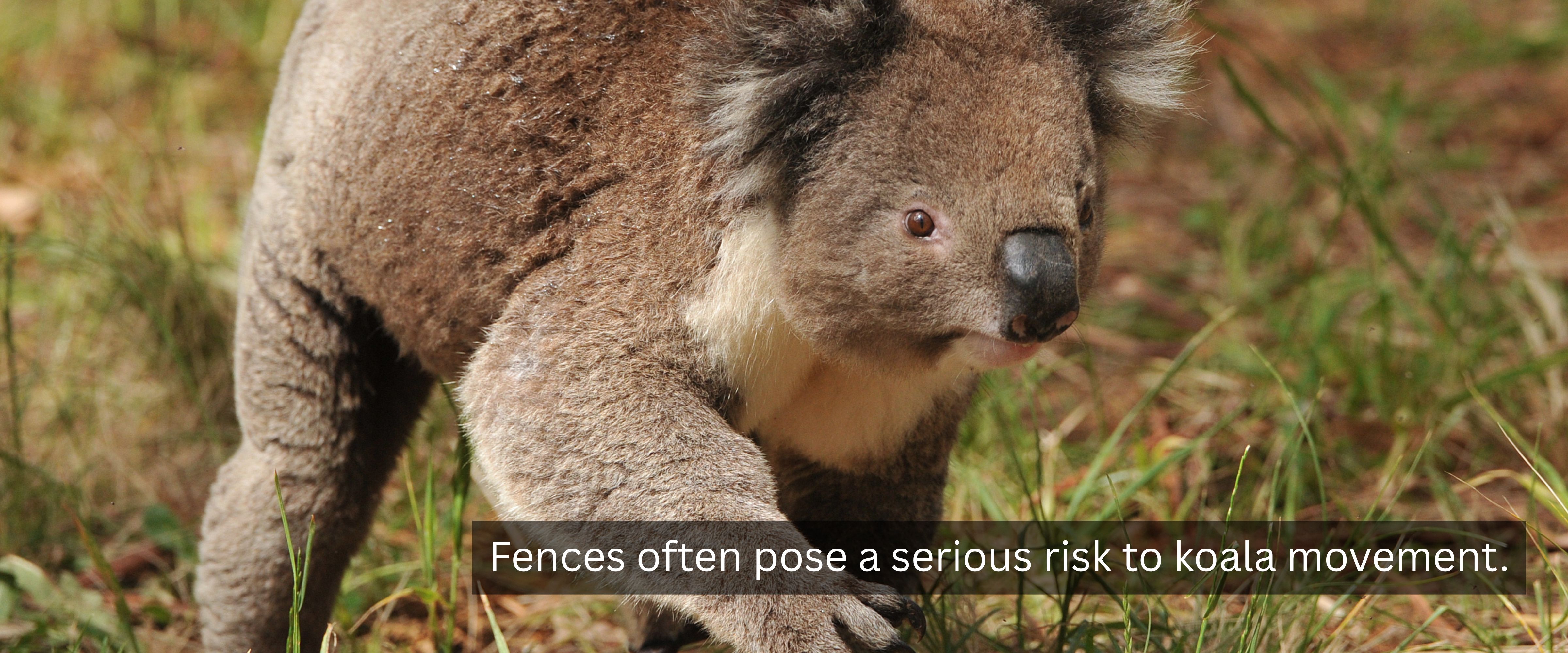
Contrary to popular belief, koalas do move about on the ground. Yes, they do spend a great deal of time eating and sleeping in leafy canopies, but they often will descend trees in search of other tree food sources. In mating season—which can be across several months of the year—they get about even more, in search of mates.
Koalas do get a lot of their water intake in the eucalyptus leaves that they much on, but they will seek out additional water sources when needed—and this involves more time spent at ground level. This need can be exacerbated as climate change and extreme weather takes its toll on the quality of their leafy supply.
Let’s now add to this, increasing habitat losses and habitat fragmentation caused by urban development, and we see koalas moving about on the ground even more. All this time down on the ground opens koalas to increased threats of dog attacks and vehicle strikes—two high contributors to koala mortality rates.
The future of koalas living near urban populations depends greatly on their ability to move through their home ranges safely. But fences can pose a major barrier and threat.
Our fences may be causing koalas more harm that we realise, and certainly more than we intend!
Fences That Harm Koalas
Some fences pose great risk to a koala’s movement, and—in worser cases—can even cause injury or death. Here are some of the risks we want to avoid:
- Barbed wire fences can result in painful injuries or fatalities for koalas who try to climb.
- Solid fences, such as brick and Colorbond, can trap koalas in urban areas and prevent access to food trees and potential mates.
- Fences that trap koalas in backyards can lead to serious,
and often fatal, dog attacks.
- Fences that have gaps between palings of more than 10cm can trap koalas between them.
- Chain wire fences may be tricky to climb, especially those with a flopping top that falls in the direction the koala is trying to climb up from.
- Fences designed to keep koalas off a property can cause displacement, forcing koalas to navigate roads and other urban areas, placing them at high risk of vehicle strikes.
- Removing all surrounding trees and vegetation around fences removes climbing aids for koalas.
- Joeys can be separated from their mums by koala (un)friendly fences.

Koala-Friendly Fences
Here are some tips on how you can make your new or existing fences koala-friendly. You can also download our printable PDF guide here for more.
- Create koala bridges: lean timber logs (of around 15cm in diameter) on an angle against non-climbable fences every 10-20 metres. Ensure the bridge is complete on both sides of the fence.
- Avoid barbed wire. Where a barbed wire security topping is necessary, create safe koala bridges (as above).
- Leave a gap (at least 30cm) under the fence to allow koalas the space to move under.
- Ensure palings and rails are placed closer than 10cm or are large enough for koalas to pass through (more than 30cm).
- A capping along the top of a fence can make it easier for koalas to walk along. A continuous series of flat boards is ideal.
- Design fences around existing trees and vegetation, allowing koalas to utilise these for their crossing. This also provides an element of safety for koalas trapped in backyards with dogs. Alternatively, plant new trees and sturdy shrubs.
- Don’t forget your swimming pool! Ensure your pool fencing is not only child-proof, but koala-proof. Consider adding a rope at one end of the pool that is attached to a nearby pole or tree.
- Consider, are fences really required? Unless you have dogs to confine, is a fully enclosed fence required on your property?

Have more tips? We would love to hear from you!
And should you wish to speak to us for guidance about your own fencing, please don’t hesitate to reach out to our friendly team of volunteers.
By Madeleine Coyle, with special thanks to QKC Research Coordinator, Jessie Maclean
Sources and Further Information
Environmental Planning and Policy, Department of Environment and Science (2020), Koala-sensitive Design Guideline: A guide to koala-sensitive design measures for planning and development activities, Queensland Government
Koala Friendly Fencing, Gold Coast Council
Wildlife Friendly Fencing and Netting
A project that “seeks solutions to the impact of fencing and fruit netting on Australian wildlife”, you can download their brochure here: Wildlife Friendly Fencing